- Research
- Structural Engineering
Research

Structural engineering plays a leading role in designing structures belonging to social infrastructure such as bridges, power plants, and dams.
Because infrastructure structures are very large and serve a large number of people, the collapse of civil structures can result in devastating disasters.
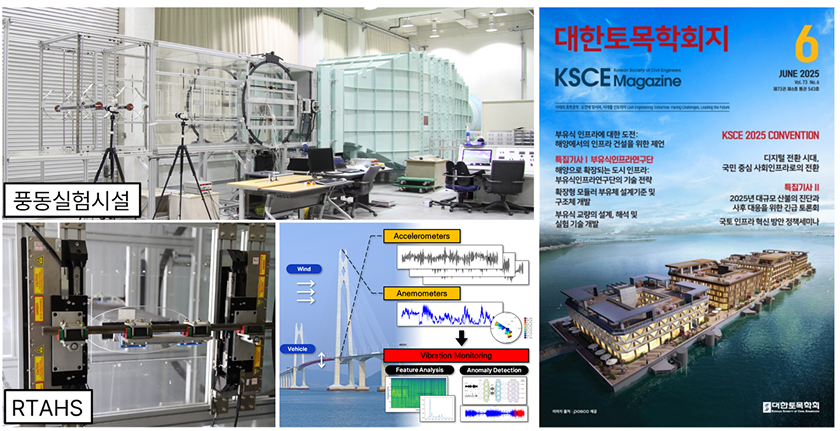
The Structural Design Lab presents engineering solutions applicable to actual design for structural systems subject to complex environmental loads, such as long-span bridges and floating structures. We are researching integrated structural design and operation solutions that increase design reliability by precisely predicting structural behavior in uncertain environments, and further encompass user safety and usability.
The main research areas consist of wind engineering-based bridge research, next-generation floating infrastructure (floating bridges, energy platforms, etc.) research, and AI research based on experiment, analysis, and measurement data. This laboratory uses its own state-of-the-art wind tunnel testing facilities and real-time aeroelastic hybrid simulation (RTAHS) technology to verify the aerodynamic stability and dynamic behavior of bridges from a design perspective. In addition, we conduct wind tunnel experiments and driving stability analysis and simulation for vehicles in parallel to propose vehicle control speed and traffic operation standards according to weather conditions. In addition, floating infrastructure research presents a feasible design framework through wind-wave linkage analysis and concept design and safety evaluation considering extreme marine environments, while data-based AI research utilizes various structural response data, meteorological observation data, as well as satellite images to develop prediction and design support technologies that complement existing analysis-based design.
Through this, our laboratory pursues empirical and reliable structural system design and implementation technology that organically integrates experimentation, analysis, and data-based approaches.
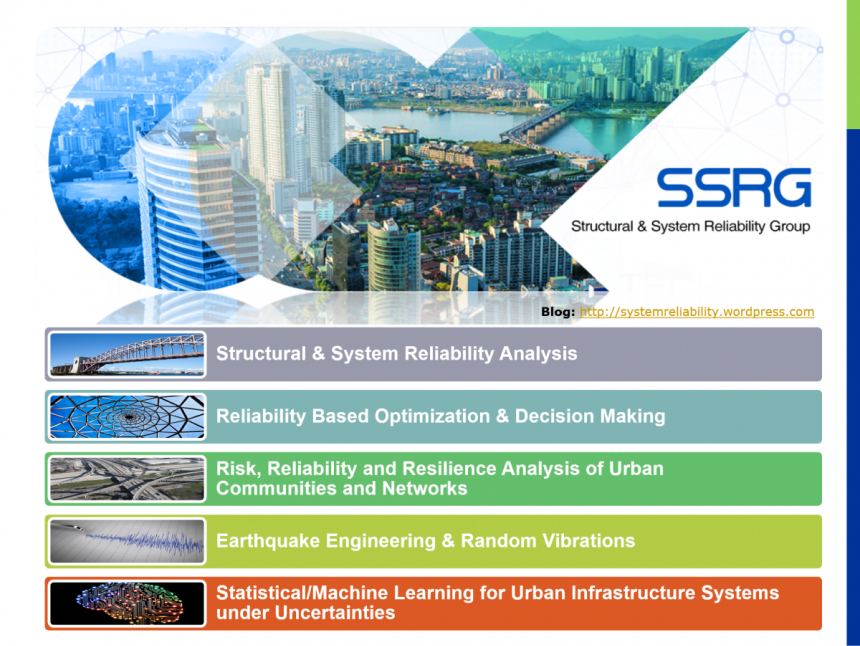
Various forms of uncertainty inherently exist in the various construction and urban infrastructure systems that play a central role in complex modern society and the external environment surrounding them. Probabilistically modeling these uncertainties and quantitatively evaluating and predicting system performance and reliability based on this is very important for rational decision-making regarding the planning, design, construction, operation, maintenance, and disaster response of social infrastructure.
To this end, Seoul National University's Structural Reliability Laboratory (1) develops and applies cutting-edge methodologies for efficient and accurate reliability analysis of complex built environment systems, (2) develops optimal design and performance-based design techniques for structures through a combination of high-performance computer simulations such as finite element analysis and reliability analysis, (3) develops methodologies to effectively evaluate the disaster response performance and system reliability of complex social infrastructure networks such as gas, water, power, and transportation and applies them to real-time analysis and operational decision-making, (4) determines the uncertainty of seismic and environmental loads. We are actively conducting research on (5) random vibration analysis of the considered structures and its application to earthquake-resistant and disaster-prevention design, and (5) data analysis and prediction model development based on statistical learning, machine learning, and deep learning for urban infrastructure systems containing uncertainty.
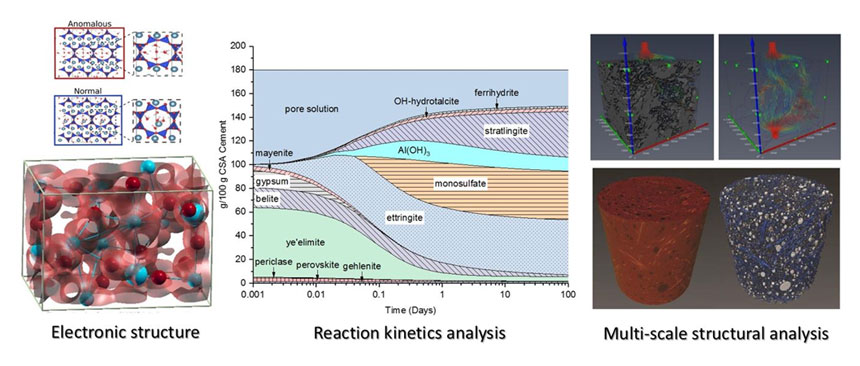
The Multiscale Structural Materials Laboratory aims to develop and apply next-generation structural materials. Next-generation structural materials refer to materials designed to not only serve as traditional structural materials, but also to perform a variety of functions such as being eco-friendly, ultra-light, and equipped with self-healing or magnetic sensing functions.
Recently, we are actively conducting CCUS research using mineral carbonation technology, and through this, we are striving to contribute to carbon neutrality 2050 and build more sustainable and safe social infrastructure and smart cities.
- Research on Carbon Neutrality 2050
- Development and application of advanced material analysis techniques (Advanced Material Characterization)
- Development of Next-generation Functional Catalyst & Various Admixtures
Concrete is the most widely used and essential structural material for building social infrastructure such as bridges, tunnels, dams, underground structures, and power plants. Therefore, the planning, design, construction, construction, and maintenance of concrete structures are always important social issues.
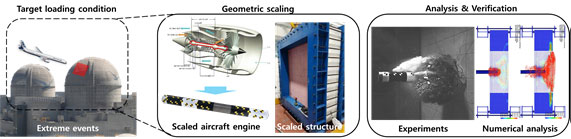
In addition, interest in concrete structures is developing into a wide range of areas, including large-scale social infrastructure such as high-rise buildings and ultra-long bridges, and the behavior of structures under extreme situations such as terrorist incidents, accidents, and ship collisions. To this end, experimental and analytical research that can predict and analyze the behavior of concrete structures exposed to various environments using world-class experimental equipment and facilities is essential, and the Concrete Structure Research Laboratory is conducting a variety of research focusing on the following topics related to concrete structure design standards.
- Development of performance evaluation and design standards for concrete members using high-strength rebar and high-performance concrete
- Development of safety diagnosis and maintenance techniques for aged bridges
- Verification analysis and experiment related to road bridge design limit state design method
- Observation, evaluation, experiment and analysis of concrete material/member behavior under impact load
- Development of extreme cold area structure design and construction methods
- Development of standard testing procedures for extreme performance
The Applied Structural Dynamics Laboratory performs advanced analysis and dynamic experiments to analyze how social infrastructure structures such as bridges, plants, and buildings behave under dynamic loads such as earthquakes and wind.
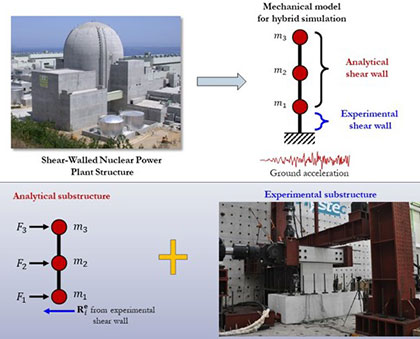
Our lab's main research topics include structural vibration control, seismic performance evaluation, nonlinear dynamic analysis, and real-time hybrid simulation (RTHS).
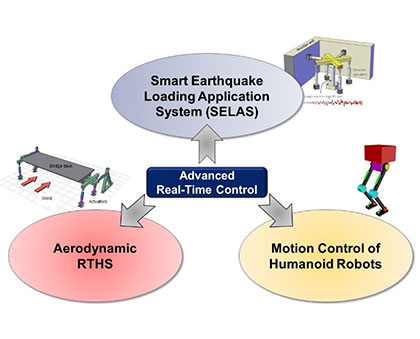
In particular, real-time hybrid experiment is a next-generation experimental technique that allows very efficient analysis of the behavior of large structures during earthquakes, allowing three-dimensional dynamic seismic loads to be applied to the structure in real time. Because the parts with severe nonlinearity or difficult to analyze behavior are tested, and the remaining parts are modeled and tested analytically, the seismic performance evaluation of large structures can be performed economically and reliably. This can be applied not only to seismic loads, but also to wind loads, wave loads, etc., so it can also be applied to the analysis of the aeroelastic behavior of bridges and the wind-fluid-structure interaction behavior of offshore structures.
Furthermore, we plan to actively participate in the development of robots that can be used in disaster sites and high-risk construction sites by applying the real-time displacement/load control algorithm of our laboratory to high-speed motion control of humanoid robots.
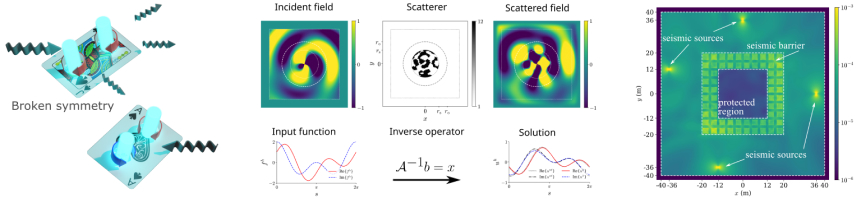
The Structural Analysis Laboratory presents engineering solutions to various social problems while pursuing advancements in the fields of engineering, mechanics, mathematics, and computing.
Waves, such as elastic waves, sound waves, or electromagnetic waves, are physical phenomena that transfer energy through a medium. Static analysis of wave phenomena allows us to predict how natural or engineered systems will respond to waves. On the other hand, wave-based inverse analysis problems are used as a powerful tool to solve various engineering problems by extracting information from data.
This laboratory studies wave physics through analytical and numerical methods, and based on this, we aim to identify structures or systems and design engineering devices to control and utilize wave propagation. Based on this methodology, the structural analysis laboratory covers various fields such as wave scattering, ground exploration and energy transfer, seismic wave control, non-destructive testing, analog computing, and image processing.