- Research
- Geotechnical Engineering
Research

Geotechnical engineering is a field that deals with various theories necessary for the engineering use of the ground. It understands the mechanical characteristics of the ground and studies environmental pollution problems of the ground, such as analysis and design, construction and maintenance of actual ground structures.
The Geotechnical and Geoenvironmental Engineering Laboratory is conducting research in the areas of geotechnical environmental investigation, which investigates the mobility and characteristics of contaminants by examining the characteristics of the ground and contaminants, landfills where ground contaminants are buried, and the areas of removing and purifying contaminants from already contaminated soil and groundwater.
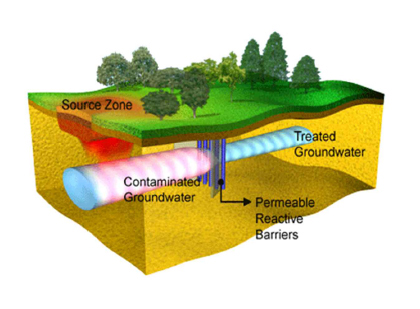
- Reactive wall: Ground purification using the permeable reactive wall method has the advantage of being installed at a low cost, reducing future operation and maintenance costs, while effectively purifying contaminated ground.
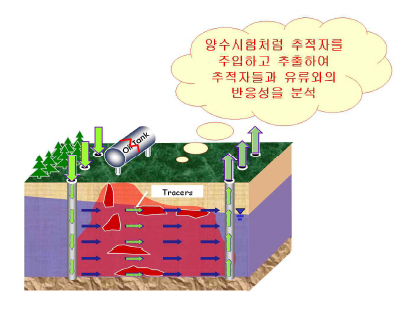
- Contaminated soil purification: Research is underway to develop soil washing technology that adopts physical, chemical, and thermal treatment methods to purify soil contaminated with heavy metals or oil.
- Soil follow-up management: Compared to the recent increase in the amount of purified soil, no proper utilization plan has yet been proposed, so research is underway to establish a virtuous cycle purified soil recycling system.
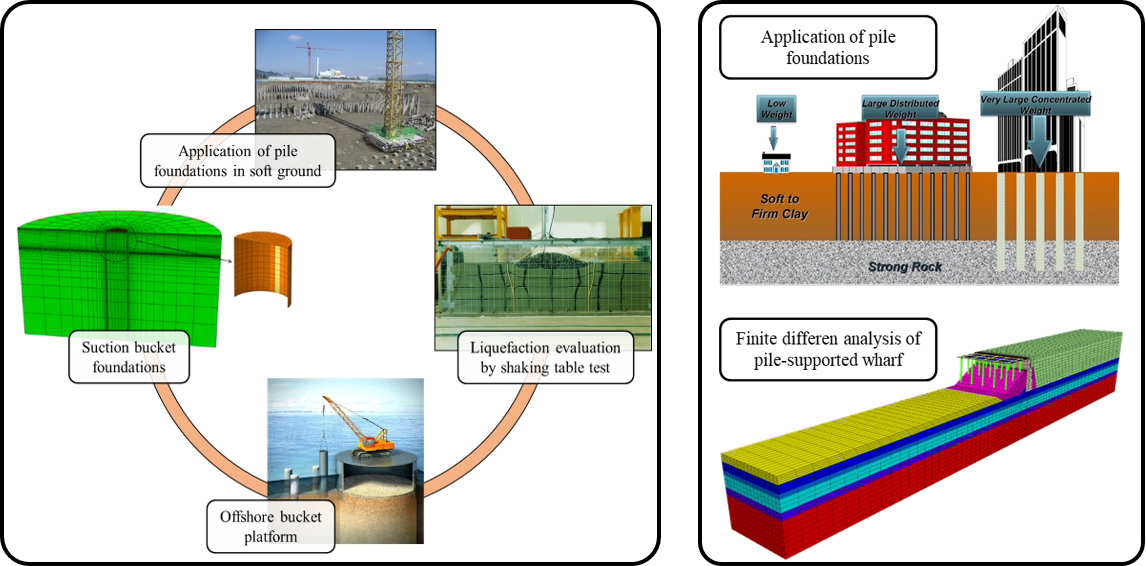
‘All loads from the superstructure are transmitted to the lower ground through the foundation structure.’ This phrase speaks of the importance of geotechnical engineering technology as it means that all structures are supported by the ground and foundation structures, so the ground and foundation structures must be strong for the superstructure to perform properly.
Recently, the importance of new and advanced geotechnical engineering is becoming more prominent as areas that were previously avoided due to poor ground conditions, such as marine spaces, reclaimed ground, and deep soft ground, are being developed.
At the same time, as strong earthquakes such as the recent Gyeongju earthquake and Pohang earthquake repeatedly occur, the role of geotechnical earthquake-resistant engineering is also growing. This laboratory is conducting research in the fields of foundation system design and geotechnical structure earthquake resistance design as follows.
- Reactive wall: Ground purification using the permeable reactive wall method has the advantage of being installed at a low cost, reducing future operation and maintenance costs, while effectively purifying contaminated ground.
- Contaminated soil purification: Research is underway to develop soil washing technology that adopts physical, chemical, and thermal treatment methods to purify soil contaminated with heavy metals or oil.
- Soil follow-up management: Compared to the recent increase in the amount of purified soil, no proper utilization plan has yet been proposed, so research is underway to establish a virtuous cycle purified soil recycling system.
The SNU Geomechanics Lab investigates how soils, rocks, and other porous and granular materials behave and interact with engineered systems in natural and built environments. We integrate physics-based modeling, computational simulation, experimental characterization, and artificial intelligence to understand and predict deformation, failure, and coupled multiphysical processes in geomaterial systems across scales. Our research underpins a broad range of applications spanning infrastructure, mobility, energy, and environmental systems.